
Running a Sex Offender Check in Gillespie County
The Texas Public Sex Offender Registry is the main public source for Gillespie County. Texas DPS maintains the statewide data, while the local registration authority receives updates and performs duties set by state law. Searchers can use a name, an address, the county filter, a city, a ZIP code, an institute of higher education, or the map. Results should be treated as official public information, not as a basis for confrontation.
Location controls the local contact. A registrant who lives inside Fredericksburg generally reports to Fredericksburg Police. A person living elsewhere in Gillespie County generally reports to the Gillespie County Sheriff. Both agencies operate from the Law Enforcement Center at 1601 E. Main Street, but they are distinct custodians. Call 830-997-7585 and state which authority you need. If an address or status seems wrong, report the precise field to that authority so it can be checked through official channels.
Gillespie County Registry Boundaries
Gillespie County has one incorporated city. That makes the municipal boundary more important than the shared building address. Chapter 62 directs a person who resides in a municipality to register with municipal police; outside a municipality, the sheriff is the registration authority. Fredericksburg Police and the Gillespie County Sheriff both use the Law Enforcement Center contact route, so a caller should say whether the registered address is inside Fredericksburg.
Local Registration Contacts
Fredericksburg Police or Gillespie County Sheriff
1601 E. Main Street
Fredericksburg, TX 78624
830-997-7585
Texas law generally requires local registration no later than the later of seven days after arrival or the agency's first policy-allowed registration date. The local office can explain its current check-in process. The public profile, rather than a caller's guess, should guide which authority to contact.
Searching the Texas Public Sex Offender Registry
Start with the official DPS form and narrow the query only as far as the facts support. A broad Gillespie County search can catch spelling changes or aliases, while an exact name can reduce unrelated results. Address searches help with a known street or nearby area. Map results are useful for context, but rural descriptive locations may not produce a clean pin.
- Open the Texas registry and review its conditions of use before searching.
- Select name, address, higher-education, or map search. Choose Gillespie County when a county filter fits the question.
- Compare the result list by name, alias, age, location, and status. Do not rely on one matching name.
- Open the profile and read the registration authority, verification details, offense entry, and address data together.
| Field or control | Type | Required | Use |
|---|---|---|---|
| Search type | Tabs | Yes | Name, address, institute, map, or subscription functions |
| Last and first name | Text | Conditional | Last name drives a name search; first name narrows it |
| Address and city | Text or select | Conditional | Finds a known address or Fredericksburg locality |
| County and ZIP | Select and text | No | Choose Gillespie or enter a five-digit ZIP |
| Radius and map | Select and map | No | Shows nearby geographic results when the location maps |
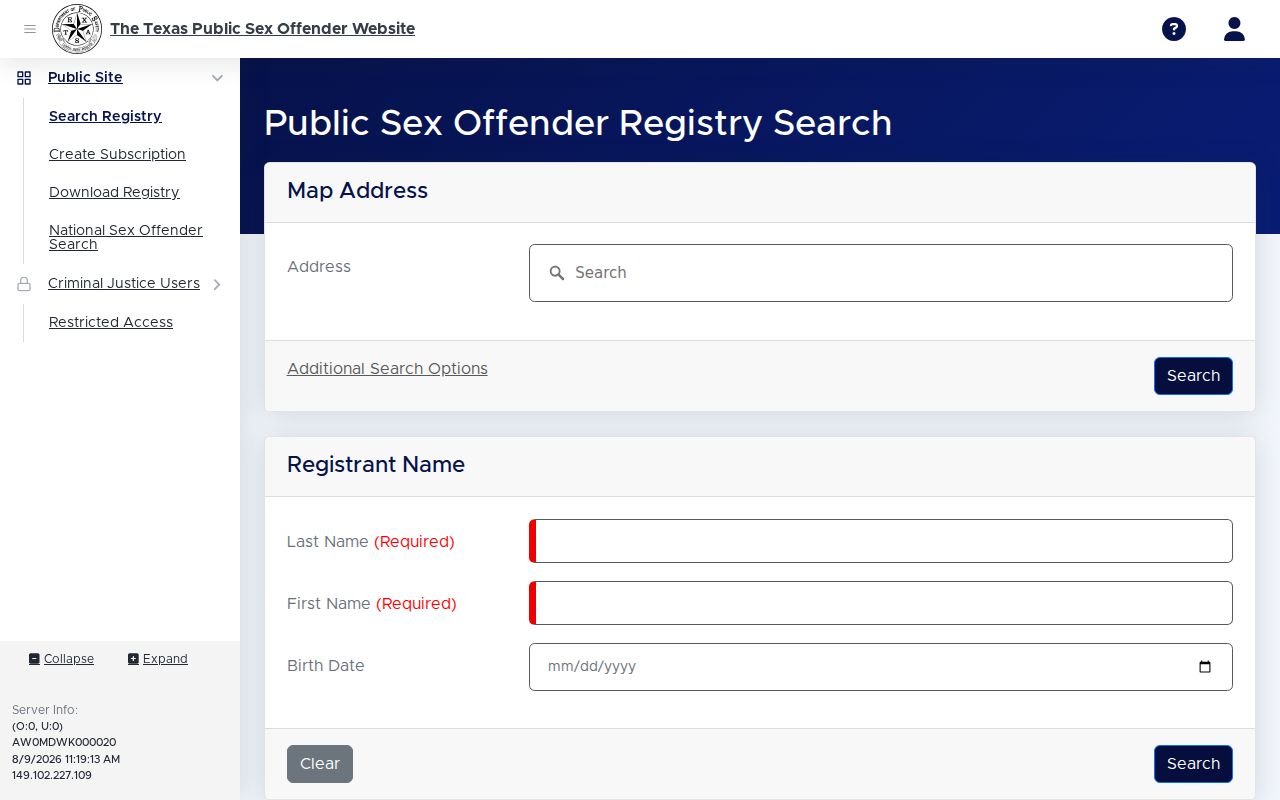
The official registry search screen shows the available name, address, county, and map routes.
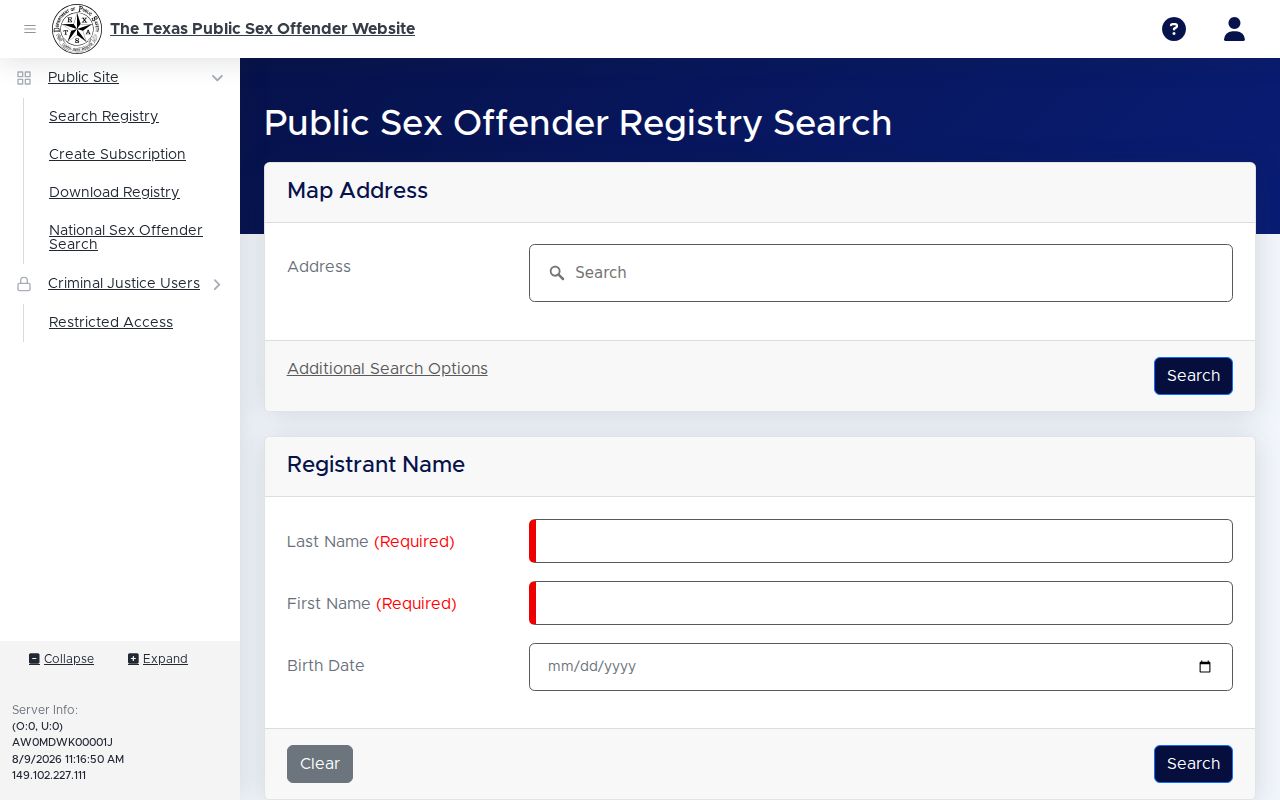
The screen illustrates why the same Gillespie County question can be approached through several fields rather than one name box.
Gillespie County Registry Subscriptions
A CRD Public Website account can support Public Sex Offender Subscriptions. This option is useful for ongoing community awareness because a saved area can be checked again without depending on memory or an old screenshot. The exact address and radius controls are session-dependent, so review the live form when setting the subscription. An alert should lead back to the current official profile.
The wider CRD account also houses a public conviction name-search product, but that is a different record system. The DPS Criminal History Conviction Name Search deals with reported convictions and deferred adjudications, uses paid credits, and does not replace the free registry.
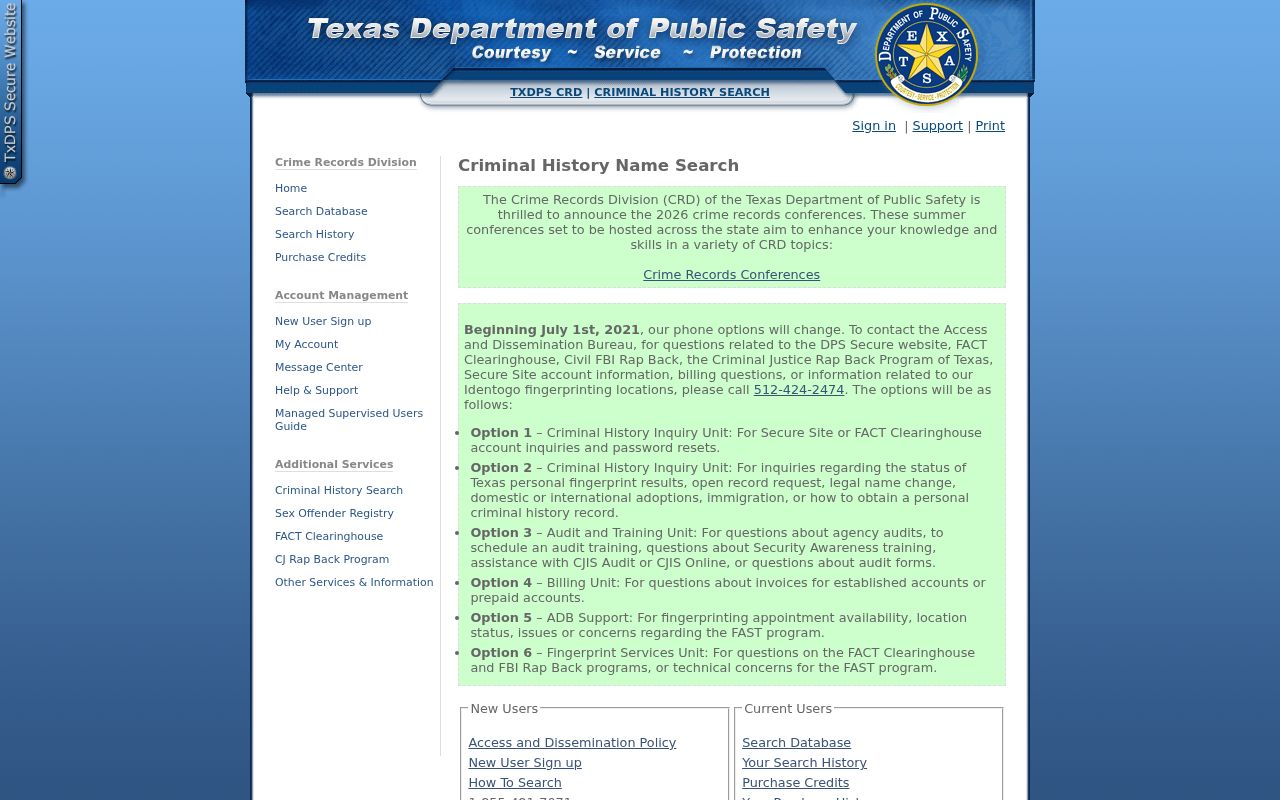
Keeping these DPS products separate prevents a paid conviction search from being mistaken for a Gillespie County registry check.
What a Registry Profile Shows
A public Texas profile combines identity clues, location, registration status, and offense information. It may also show a photograph, public physical descriptors, marks or tattoos, and vehicle details when those fields are collected and public. Read the page as a whole. An old image, a shared name, or an address alone is not enough to identify someone safely.
| Name and aliases | Current public name plus reported aliases that may explain a search mismatch |
|---|---|
| Photo and description | Photograph, sex, race, age or birth information, height, weight, hair, and eye color |
| Registered location | Public address or geographic description and the local registration authority |
| Status and verification | Registration status and available verification information |
| Offense record | Offense description or statute, adjudication date, victim age category, and punishment when published |
| Other public fields | Institution, scars, marks, tattoos, and vehicle data when applicable |
The DPS registry profile layout organizes these public fields without exposing the confidential fields held by the agency.
The layout helps readers distinguish a public offense entry from local verification and location details.
Registration Requirements and Levels in Texas
Texas does not present its public registry as a simple federal Tier I, II, and III list. Duration turns on the reportable offense, repeat or sexually violent categories, age and case status, and the last applicable discharge event. Verification frequency can also depend on the legal category and local instructions. The local authority or DPS should resolve a profile-specific duty.
| Texas category | General duration | Public meaning |
|---|---|---|
| Adult lifetime-reportable category | Life | Includes specified sexually violent and repeat or other lifetime-reportable categories |
| Adult non-lifetime category | 10 years after discharge from incarceration, parole, or community supervision | The clock does not simply start on the conviction date |
| Juvenile registration | Generally 10 years after release, discharge, or dismissal, whichever is later | A court may alter the duty or make qualifying registration nonpublic |
A very old Gillespie County offense can therefore support a current listing. Time spent in custody or supervision affects the end date, and some adult categories last for life. Readers should not calculate removal from the conviction year alone.
When Gillespie County Map Pins Fail
Much of Gillespie County lies outside Fredericksburg, and a rural descriptive location may not geocode like a city street. If a map pin is missing, switch to a name search, then try Gillespie County, the closest known city or ZIP, and the national search. Compare aliases and public physical details before deciding that two results refer to the same person.
The U.S. Department of Justice National Sex Offender Public Website adds participating jurisdictions beyond Texas and gives another official route when a person may have moved across a state line.
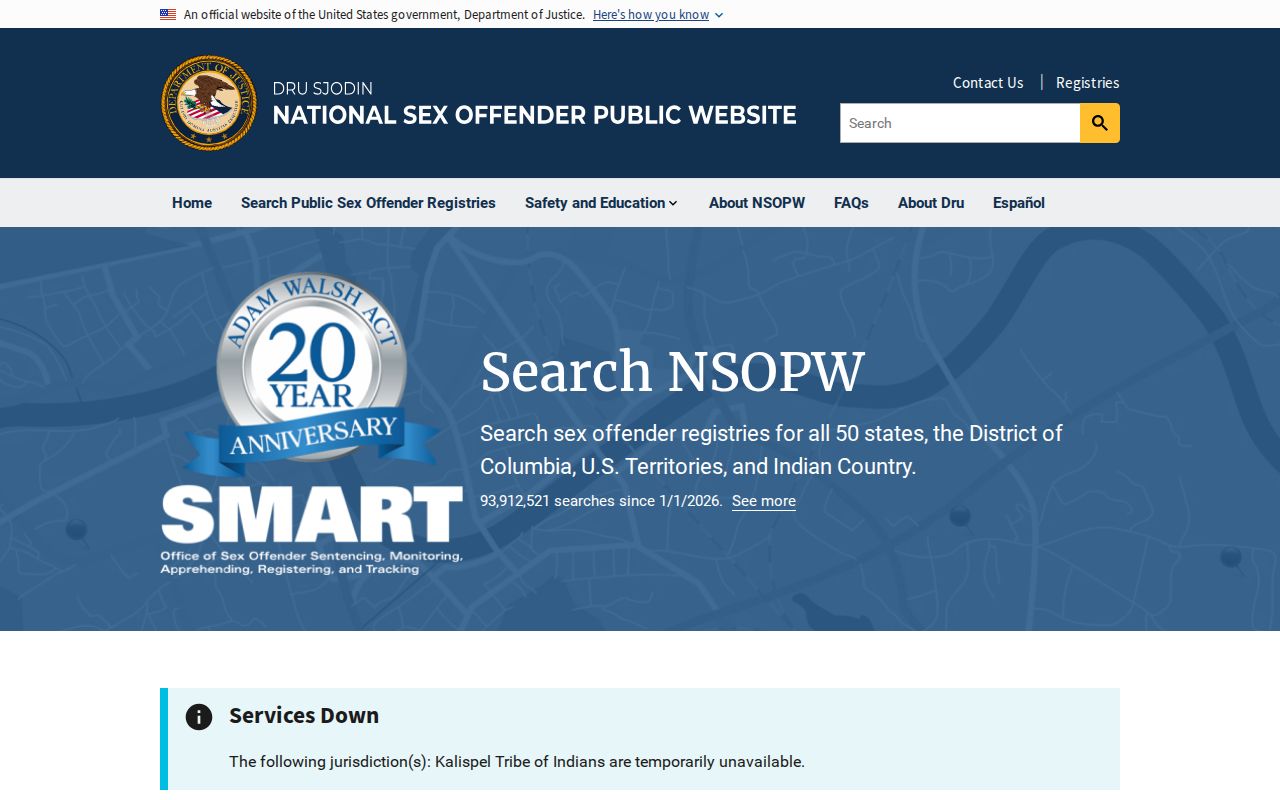
NSOPW broadens the geographic check, while the Texas profile remains the source for Texas registration details and the listed local authority.
Gillespie County Community Notification
Texas community notice is broader than the searchable website. Chapter 62 supports public registry access, local registration work, school notification when required, permissible publication, and DPS postcard notice for certain high-risk or civilly committed sexually violent predators. These routes do not make every field public, and they do not replace a current profile check.
For personal or family safety, save the official source and verify the profile date. If suspected noncompliance involves an address or failure to register, contact Fredericksburg Police inside the city or the Gillespie County Sheriff outside it. Give facts, not conclusions. Law enforcement can compare the report with nonpublic registration material and decide what response is proper.
Lawful Use and Community Notification
Registry data is meant to support informed personal, family, and neighborhood safety choices. It should be read with care because addresses change, map placement can be imprecise, and the public page omits protected details. Verify current information with the listed registration authority. Never confront a person based on a search result.
Registry misuse warning: The Texas Code of Criminal Procedure Chapter 62 governs registration and public notice. Texas DPS warns that using registry information to threaten, intimidate, harass, or commit another crime is unlawful and can undermine public safety.
Report a suspected violation through the proper local agency. For an address inside Fredericksburg, contact police. For an address elsewhere in Gillespie County, contact the sheriff. For a data problem in the statewide display, identify the exact profile and field when contacting DPS or the listed registration authority.